
The rule
Article 12(3) of the GDPR says a company must tell you what it has done about your request “without undue delay and in any event within one month of receipt of the request”. It can extend that by “two further months where necessary, taking into account the complexity and number of the requests”, but only if it tells you about the extension, with the reasons, within the first month.
The same clock applies to every right in Articles 15 to 22: a copy of your data, deletion, correction, objection. And if the company decides not to act at all, Article 12(4) gives it the same month to tell you why, and that you can complain to an authority or go to court.
Count the month
The European Data Protection Board (EDPB) explains the counting in its Guidelines 01/2022 on the right of access, paragraphs 159 to 161. Three rules cover almost every case:
- Start on the day the request arrives. The clock starts when the request reaches the company through one of its official channels, such as its privacy email address. The company does not need to have read it (paragraph 159).
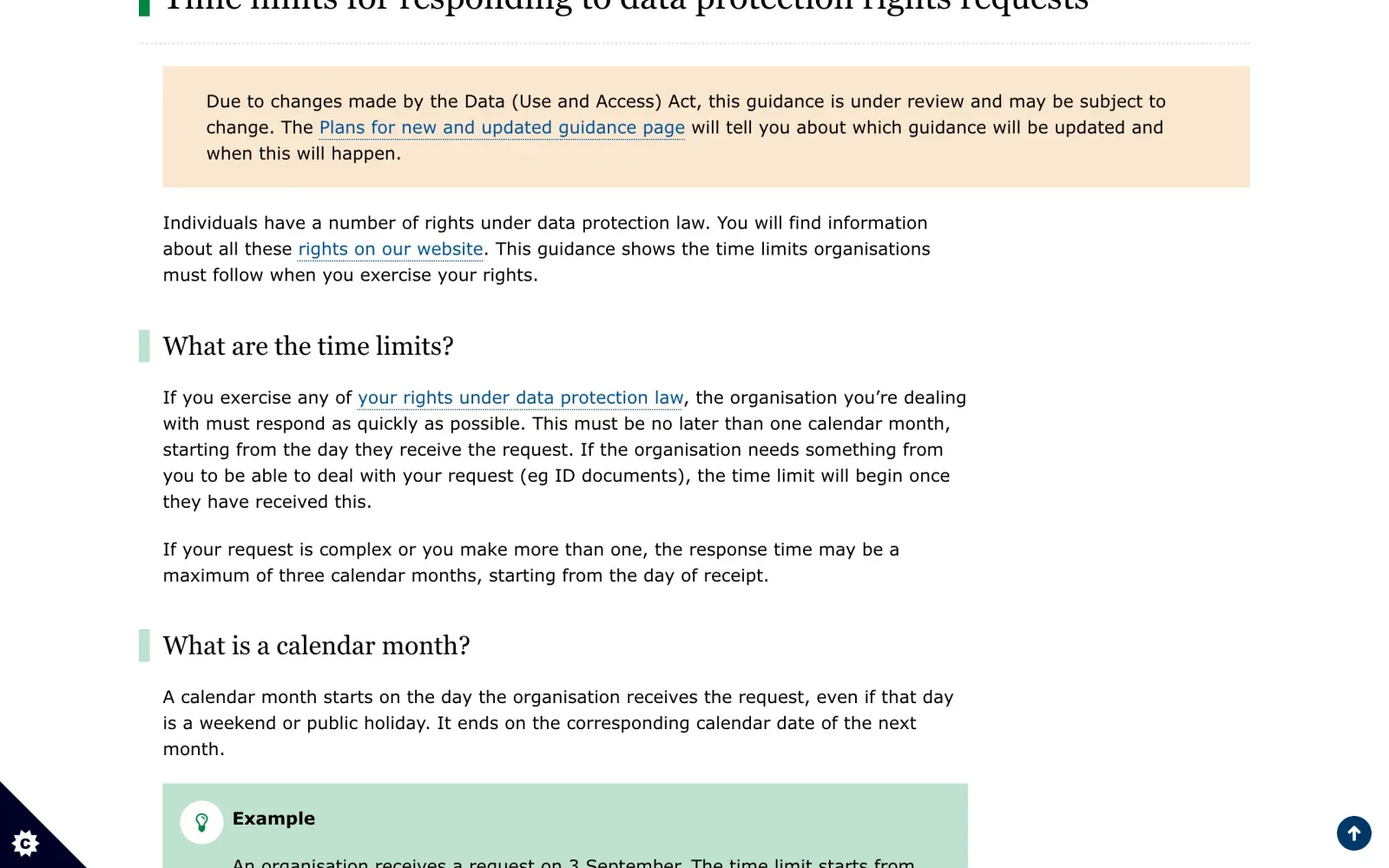
- End on the same date next month. A request received on 5 March is due “until and including 5 April” (Example 32). If next month has no such date, the deadline is its last day: a request received on 31 August is due on 30 September (Example 33).
- Weekends and holidays move it on. If the last day falls on a weekend or a public holiday, the company has until the next working day (paragraph 161).
Some examples with real dates:
| Request received | Same date next month | Deadline |
|---|---|---|
| Tuesday 3 November 2026 | Thursday 3 December 2026 | Thursday 3 December 2026 |
| Sunday 31 January 2027 | No 31 February, so Sunday 28 February 2027 | Monday 1 March 2027, the next working day |
| Wednesday 25 November 2026 (UK) | Friday 25 December 2026, a bank holiday | Tuesday 29 December 2026 in England and Wales, because Monday 28 December is the Boxing Day substitute bank holiday |
Public holidays differ from country to country, so a deadline can fall on a different day in Italy than in Germany. When in doubt, count from the same date and allow a working day or two.
When the company extends
Say the company receives your request on Tuesday 6 October 2026 and it is genuinely complex. To extend, it must write to you, with its reasons, by Friday 6 November 2026. If it does, the final deadline becomes Wednesday 6 January 2027, three months from your request.
The EDPB calls the extension “an exemption from the general rule” that “should not be overused” (paragraph 162). A large effort alone does not make a request complex, and nor does a big company getting many requests (paragraph 164).
When the company asks who you are
If the company has reasonable doubts about your identity, it can ask for the information it needs to confirm it (Article 12(6)). In the EU, the EDPB says the clock is then suspended until you reply, provided the company asked “without undue delay” (paragraph 159). Because the clock pauses rather than restarting, the days already used still count.
The same pause applies when a company that holds a lot of data asks you to say which information or processing your access request is about (Recital 63, paragraph 159).
The UK since 5 February 2026
The UK kept the GDPR after Brexit as the UK GDPR. The Data (Use and Access) Act 2025, section 76, added Article 12A, which came into force on 5 February 2026. It keeps the one month and the two-month extension, and writes down exactly when the month starts.
The month begins at “the relevant time”, which is the latest of:
- when the company receives your request;
- when it receives the information it asked for to confirm your identity under Article 12(6);
- when you pay a fee it charged under Article 12(5). A fee is allowed only for requests that are manifestly unfounded or excessive, so most people never pay one.
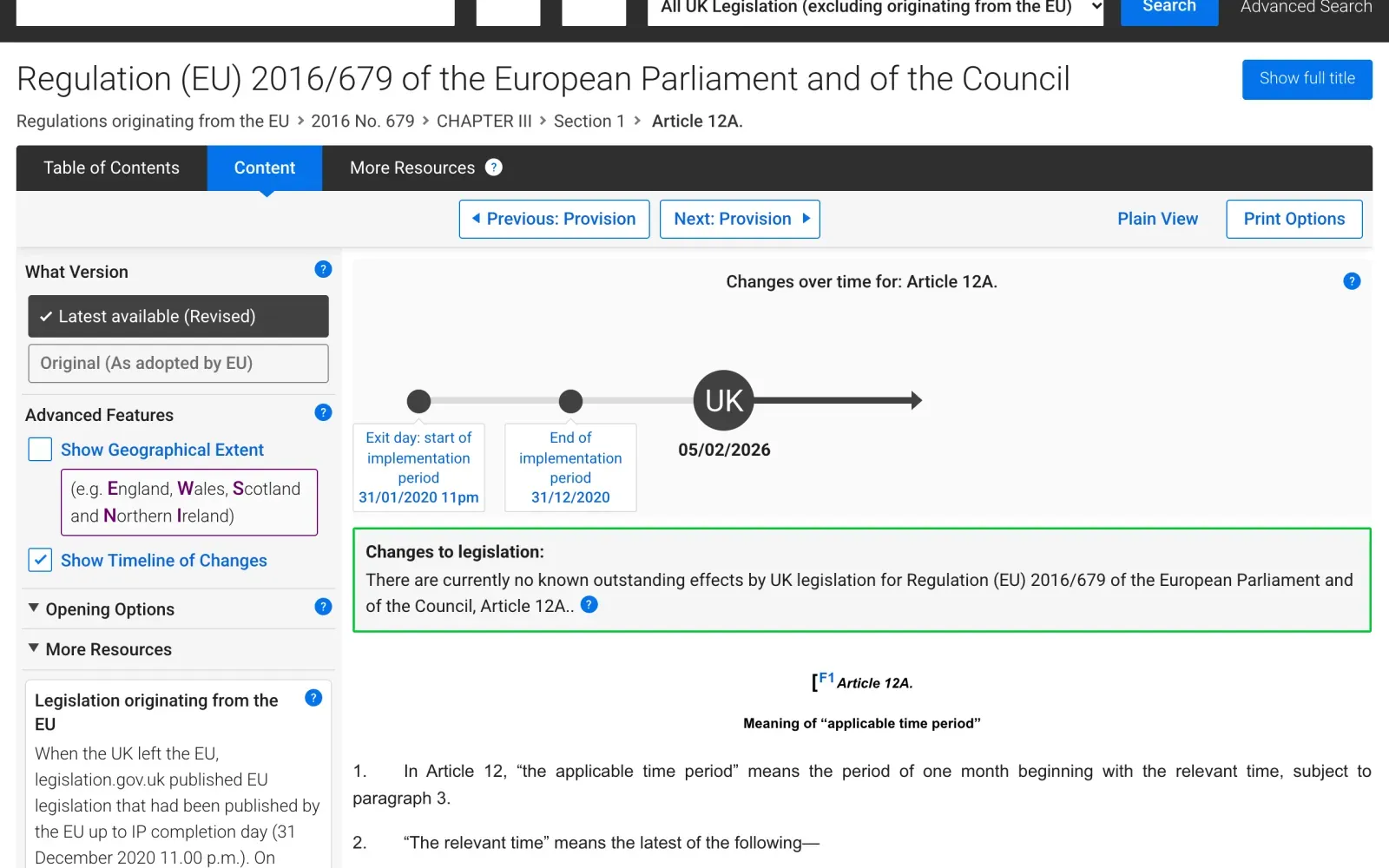
Identity checks work differently in the UK. In the EU, a check pauses a clock that is already running. In the UK, the clock does not start until the company has what it asked for. For example, a UK company receives your request on Monday 2 March 2026, asks for ID on Wednesday 4 March, and you reply on Monday 9 March. The month runs from 9 March, so on the ICO’s way of counting the deadline is Thursday 9 April 2026.
The other rules in Article 12A:
- Extension. The company can add two more months for complex or numerous requests. It must tell you, with reasons, before the first month ends (Article 12A(3) and (4)).
- Clarifying an access request. If you asked for a copy of your data and the company reasonably needs more detail to find it, for example because it holds a large amount of information about you, it can ask. The days from its question to your answer do not count (Article 12A(5) and (6)).
- Refusal. If it will not act, it must tell you why within the same period, and that you can complain to it under section 164A of the Data Protection Act 2018, complain to the ICO, or go to court (Article 12(4)).
The ICO counts the month the same way as the EDPB: from the day of receipt, even a weekend, to the corresponding date next month, moving to the next working day if that is a Saturday, Sunday or bank holiday. Its page notes that its guidance is under review after the Data (Use and Access) Act.
What counts as an answer
By the deadline, the company must have sent you one of the replies marked Yes below.
| What you received | Does it count? | Your new deadline |
|---|---|---|
| Your data, or confirmation that it was deleted | Yes | None. Check it is complete |
| An extension, with reasons, within the first month | Yes, for now | Three months from your request (UK: from the relevant time) |
| A refusal, with reasons and your right to complain | Yes | None. Complain if you disagree |
| A request for ID or more detail | Yes, for now | EU: the clock resumes when you reply. UK: the month starts when you reply |
| An automatic "we received your message" | No | Unchanged |
| An extension with no reasons, or after the first month | No | Unchanged |
| Nothing | No | Unchanged |
A reply that only points you to a web form or a login page is none of the answers above. Using the form can be quicker, but keep your original email and its date in case you need them later.
When the deadline passes
Write down the date the deadline passed. Then send one reminder, and if that gets no answer, complain to your data protection authority. It is free. Our guide Company ignored your GDPR request? What to do next has the reminder letter and the complaint steps for the UK, France, Italy, Germany and Spain.
If you have not sent your request yet, start with the deletion letter or the access request, and note the date you send it. In the UK, see the right to be forgotten guide.
Questions
Is it one month or 30 days?
One calendar month. A request received on 5 March is due by 5 April, whatever the number of days in between (EDPB Guidelines 01/2022, Example 32).
Does the clock start when I send the email or when the company reads it?
When the request reaches the company through one of its official channels. The EDPB says the company does not need to have noticed it (paragraph 159).
Can a company extend the deadline without telling me?
No. It must tell you within the first month and give the reasons for the delay (Article 12(3)). An extension notice that comes later, or gives no reason, does not meet that rule.
Does the deadline apply to deletion requests too?
Yes. Article 12(3) covers every request under Articles 15 to 22, including erasure (Article 17) and a copy of your data (Article 15).
What is the longest a company can take?
Three months from receiving your request, in the EU, made up of the first month plus two more. In the UK, three months from the relevant time under Article 12A, which can be later if the company first asked you for ID.
Sources
- Regulation (EU) 2016/679, the GDPR, Article 12(3) to (6)EUR-Lex, checked 15 November 2026
- Guidelines 01/2022 on data subject rights, right of access, version 2.1, Paragraphs 157 to 164, Examples 31 to 33European Data Protection Board, checked 15 November 2026
- UK GDPR, Article 12A, Meaning of applicable time period, Inserted by section 76 of the Data (Use and Access) Act 2025, in force 5 February 2026legislation.gov.uk, checked 15 November 2026
- UK GDPR, Article 12, Transparent information and modalities, Paragraphs 3 to 5legislation.gov.uk, checked 15 November 2026
- Data (Use and Access) Act 2025, section 76, Time limits for responding to data subjects' requestslegislation.gov.uk, checked 15 November 2026
- Time limits for responding to data protection rights requestsICO, checked 15 November 2026
- What to expect after making a subject access requestICO, checked 15 November 2026
- UK bank holidaysGOV.UK, checked 15 November 2026