
When the right applies in the UK
The right to be forgotten is the everyday name for the right to erasure in Article 17 of the UK GDPR. It applies to any organisation that handles your personal data under UK law, from a shop you once ordered from to an app you stopped using. A company must delete your data without undue delay when one of these grounds applies (Article 17(1)):
| Ground | What it looks like | UK GDPR |
|---|---|---|
| It no longer needs the data | You closed the account or cancelled the membership, and the data served only that | Art. 17(1)(a) |
| You withdraw your consent | It relied on your consent, for example for a newsletter, and has no other legal basis | Art. 17(1)(b) |
| You object | You object to its use and it has no overriding legitimate grounds, or the use is direct marketing | Art. 17(1)(c) |
| It used the data unlawfully | It had no lawful basis for holding the data in the first place | Art. 17(1)(d) |
| A legal obligation requires it | UK law makes it erase the data | Art. 17(1)(e) |
| You were a child | The data was collected when you signed up to an online service as a child | Art. 17(1)(f) |
| A malicious allegation | In England and Wales, data held because of an allegation by someone convicted of harassing or stalking you, which the organisation investigated and dropped | Art. 17(1)(g) |
For most people ending a relationship with a company, the first two grounds are the ones that count: the company no longer needs your data, and any consent you gave is withdrawn by the request itself.
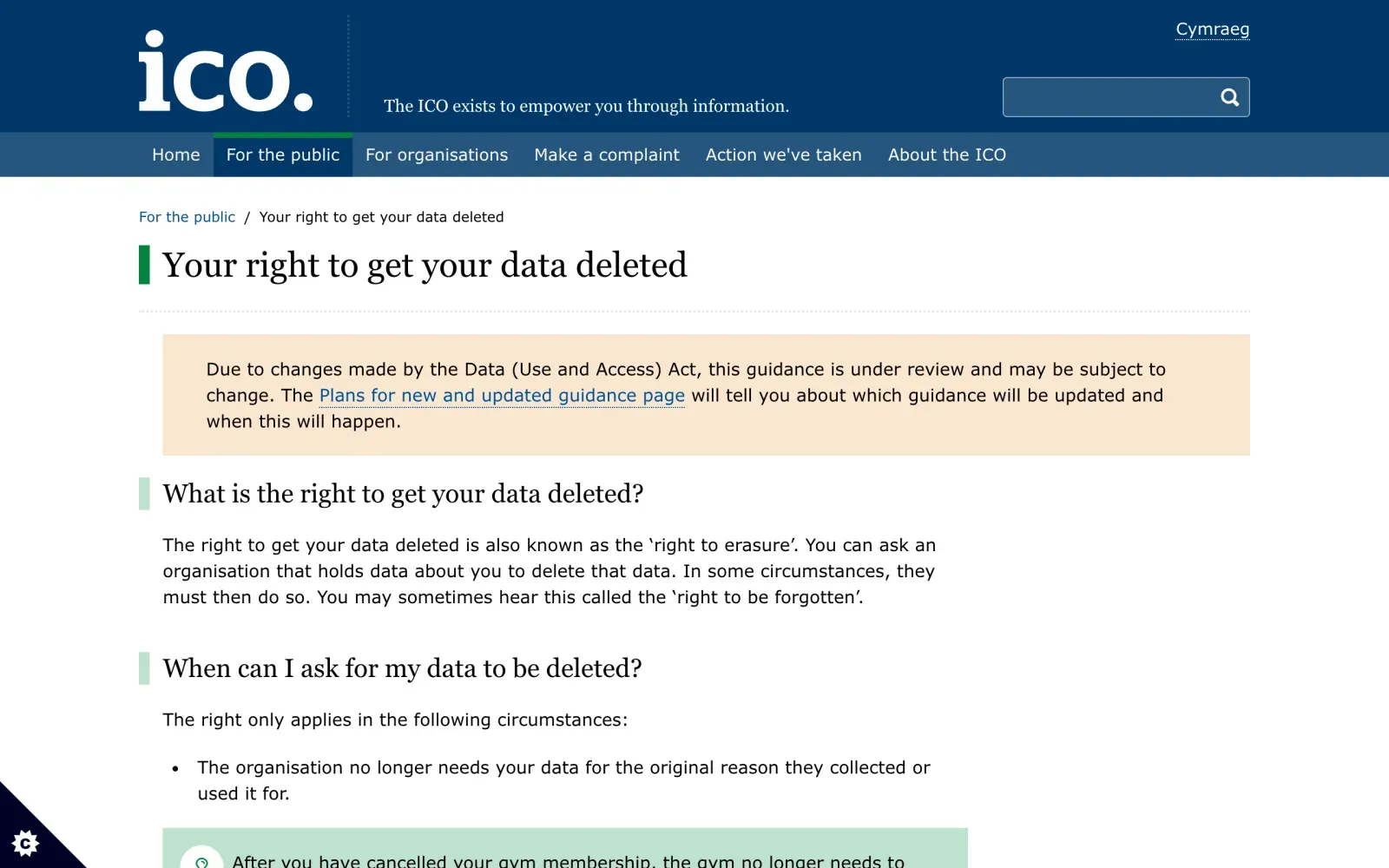
What a company may keep
Under Article 17(3), a company does not have to erase data it needs:
- to exercise the right of freedom of expression and information, which the ICO says includes journalism and academic, artistic and literary work;
- to comply with a legal obligation under UK law, such as keeping invoices for tax, or to carry out a task in the public interest;
- for public health reasons;
- for archiving in the public interest, research or statistics, where erasure would make that work impossible or seriously impair it;
- to establish, exercise or defend legal claims.
If a company keeps something for one of these reasons, it should still delete the rest. Ask it to say what it keeps and why. The letter below does this for you.
One month, and when it can be longer
A company must answer without undue delay and at the latest within one month (Article 12(3)). Since 5 February 2026, Article 12A, added by the Data (Use and Access) Act 2025, spells out when that month starts. It is the latest of:
- the day the company receives your request;
- the day it receives any information it asked for to confirm who you are, if it had reasonable doubts about your identity (Article 12(6));
- the day you pay a fee, in the rare case it may charge one (only for manifestly unfounded or excessive requests, Article 12(5)).
The company can extend the deadline by two more months when your requests are complex or numerous. It must tell you, with the reasons, before the first month ends (Article 12A(3) and (4)). A notice that arrives later, or gives no reason, does not meet that rule. The response deadline guide works through dates under Article 12A.
Send it, step by step
- Find the privacy contact.
Open the company’s privacy policy and look for a data protection officer or privacy email address, usually in a section called Contact us or Your rights. Use a web form only if it gives no address. The deletion letter guide shows where to look.
- Copy the letter below.
Fill in the company’s name, your account email and your name.
- Send it from your account's email address.
The company can then match the request to your data without asking for documents.
- Note the date.
The month runs from the day the company receives the request.
- Keep every reply.
If it asks you to confirm who you are, give only what it needs to find your account.
The letter
This version cites the UK GDPR. Fill in the three fields and copy it.
Dear [Company] privacy team,
Under Article 17 of the UK GDPR, I ask you to erase all the personal data you hold about me.
My account uses the email address [your account email]. If you keep any of my data, please tell me what you keep and the legal reason.
Please answer within one month of receiving this request, as Articles 12(3) and 12A of the UK GDPR require.
Kind regards,
[Your name]
Rather not send them one by one?
Reflex finds the companies in your Gmail, sends this letter to each from your own address and follows up for three months. Free to join the beta, €19 once when you start.
Removing search results about you
Deleting your data at a company does not remove a news article or forum post about you from Google. That is a separate request, to the search engine, to delist results that appear when someone searches your name. The ICO says you can ask a search engine to remove a result when “the search is made against your name, and the search result is affecting your privacy rights significantly”, and advises using the search engine’s own form where there is one.
Google explains its process on a public help page, which links to its request form. The form itself asks you to sign in or verify an email address.
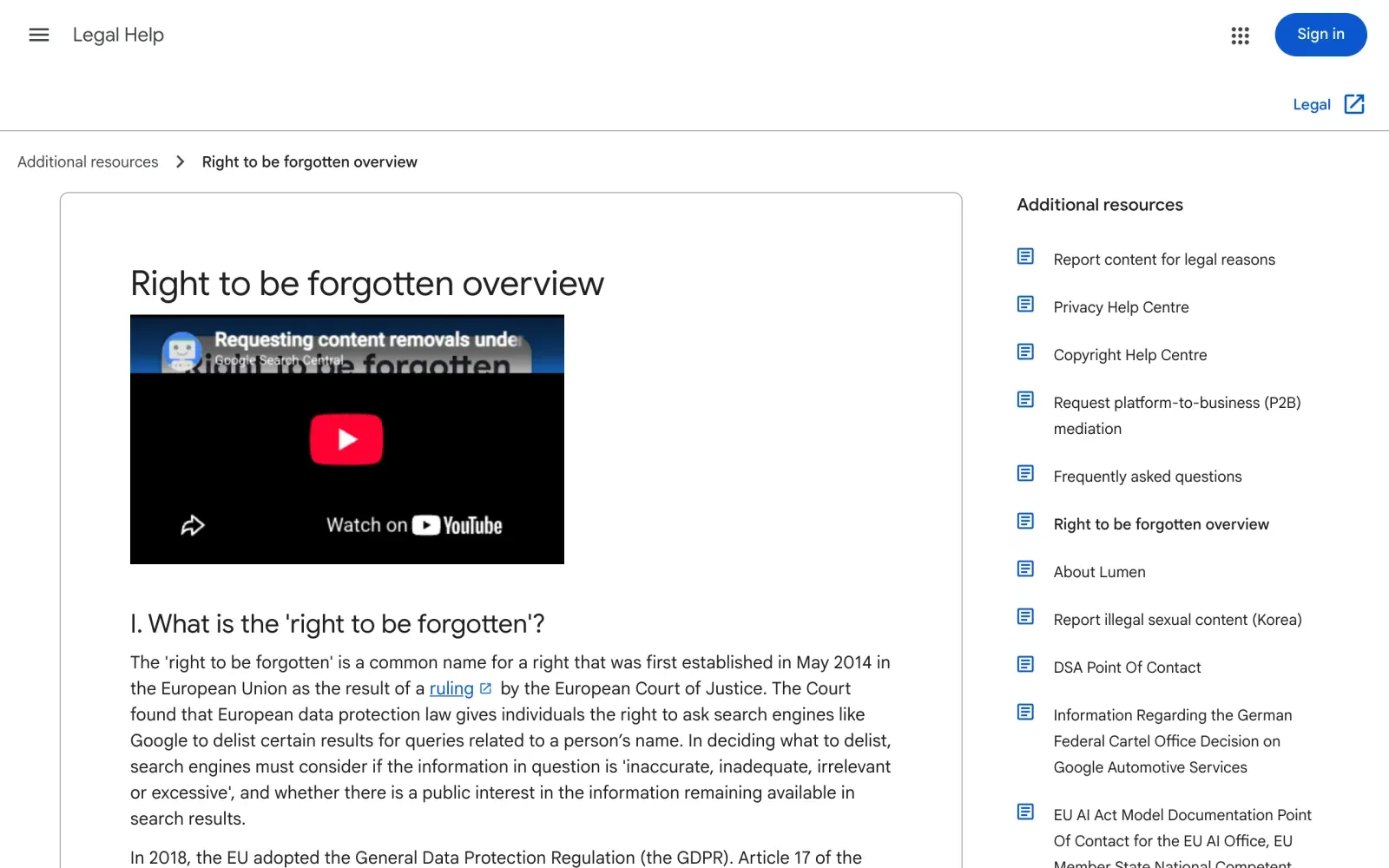
Google asks you to include:
- the exact URL of each result you want delisted;
- how the content relates to you, and why it should be delisted;
- the search query, usually your full name;
- an email address where it can reach you.
Its reviewers weigh your rights against the public interest. They look at your role in public life, whether the page is a government or news source, how old and current the information is, and whether people searching your name have a real interest in finding it. A delisted result is removed only for searches of your name. The page itself stays online, so if you can ask the site to take it down, that removes it everywhere.
If Google refuses, the ICO says you can report your concern to it, and it will consider whether the information is accurate, out of date or irrelevant, and whether the public interest outweighs the effect on you.
If the company does not answer
Since 19 June 2026, section 164A of the Data Protection Act 2018 gives you a right to complain to the company itself. It must make complaining easy, acknowledge your complaint within 30 days, and tell you the outcome without undue delay. The ICO’s guide also says to raise a complaint with the organisation first.
- Send a reminder.
Quote your original request and its date, and say the month has passed. The reminder guide has a letter for it.
- Complain to the company.
Say you are complaining under section 164A of the Data Protection Act 2018, and keep its acknowledgement.
- Complain to the ICO.
If you are still not satisfied, use the ICO’s complaint form. Under the Data (Use and Access) Act 2025 the Information Commissioner has become the Information Commission; its website and complaint form are still at ico.org.uk.
You can also go to court to enforce your rights, as the ICO’s guide notes. It strongly advises getting independent legal advice first.
Questions
Is the right to be forgotten still law in the UK after Brexit?
Yes. The UK GDPR keeps the right to erasure in Article 17, alongside the Data Protection Act 2018. The ICO calls it the right to get your data deleted.
Does a UK company have to delete my data every time I ask?
No. It must delete it only when one of the grounds in Article 17(1) applies, and it may keep data it needs for a reason in Article 17(3), such as a legal obligation or a legal claim. If it refuses, it must tell you why.
How long does a UK company have to delete my data?
One month from when it receives your request, under Articles 12(3) and 12A of the UK GDPR. It can add two more months for complex or numerous requests, but only by telling you why within the first month.
Can I make the request by phone?
Yes. The ICO says a request can be made verbally or in writing, but it advises writing so you have a record of what you asked and when.
Can I get Google to remove results about me in the UK?
You can ask Google to delist results that come up for searches of your name with its own form. If it refuses, the ICO says you can report your concern to it.
Sources
- UK GDPR, Article 17, Right to erasurelegislation.gov.uk, checked 15 November 2026
- UK GDPR, Article 12, Transparent information and modalities, Paragraphs 3 to 6legislation.gov.uk, checked 15 November 2026
- UK GDPR, Article 12A, Meaning of applicable time period, Inserted by the Data (Use and Access) Act 2025, in force 5 February 2026legislation.gov.uk, checked 15 November 2026
- Data Protection Act 2018, section 164A, Complaints by data subjects to controllers, Inserted by the Data (Use and Access) Act 2025, fully in force 19 June 2026legislation.gov.uk, checked 15 November 2026
- Data Protection Act 2018, section 165, Complaints by data subjects to the Commissionlegislation.gov.uk, checked 15 November 2026
- Your right to get your data deletedICO, checked 15 November 2026
- Internet search resultsICO, checked 15 November 2026
- Make a complaintICO, checked 15 November 2026
- Right to be forgotten overviewGoogle, checked 15 November 2026