
What you can ask for
A subject access request asks a company to show you the personal data it holds about you. The right comes from Article 15 of the GDPR. It applies to any company that handles the data of people in the EU, EEA or UK: the shop you ordered from, the app you signed up to, the airline, the streaming service.
You get two things. First, a copy of the personal data itself (Article 15(3)). Second, an explanation of how the company uses it. Article 15(1) lists what that explanation must cover:
| You are told | For example | GDPR |
|---|---|---|
| Why it uses your data | To deliver orders, to show you adverts | Art. 15(1)(a) |
| What kinds of data it holds | Contact details, payment records, browsing history | Art. 15(1)(b) |
| Who it has shared the data with | Delivery firms, advertising partners, companies outside the EU | Art. 15(1)(c) |
| How long it will keep the data | A period, or how it decides the period | Art. 15(1)(d) |
| Your other rights | To correct, erase, restrict or object | Art. 15(1)(e) |
| That you can complain to an authority | Your national data protection authority | Art. 15(1)(f) |
| Where it got the data, if not from you | A data broker, a partner shop | Art. 15(1)(g) |
| Any automated decisions about you | Credit checks or fraud scores, with the logic involved | Art. 15(1)(h) |
| Safeguards for transfers abroad | The protections used when data leaves the EU | Art. 15(2) |
Where to send it
Send it to the company’s privacy contact. Open its privacy policy and look for a data protection officer (DPO) or a privacy email address, usually in a section called Contact us or Your rights near the end.
The GDPR sets no format for the request. The EDPB, the body of EU data protection authorities, says a request sent to any channel the company provides is generally valid, even if the company prefers another one. A company can ignore a request sent to a random address, such as a marketing no-reply address, when it has given a proper channel. So use the address in the privacy policy, not the one your order emails came from.
If the company offers only a web form or a download tool in your account settings, that works too. A download tool may give you the data without the explanation listed above. If the explanation is missing, send the letter as well.
Send it, step by step
- Find the privacy contact.
The DPO or privacy address from the privacy policy.
- Copy the letter below.
Fill in the company’s name and the email address your account uses.
- Use a clear subject line.
For example: Subject access request (GDPR Article 15). The ICO suggests putting the words subject access request in the subject or heading.
- Send it from your account's email address.
The company can match the request to your data without asking for an ID document.
- Note the date.
The one-month deadline starts when the company receives your request.
The letter
Fill in the three fields and copy it. The words that change are highlighted.
Dear [Company] privacy team,
Under Article 15 of the GDPR, I ask for a copy of all the personal data you hold about me.
Please also tell me why you use it, what kinds of data you hold, who you have shared it with, how long you will keep it, where you got it if not from me, and whether you make automated decisions about me.
My account uses the email address [your account email].
Please answer within one month of receiving this request, as Article 12(3) of the GDPR requires.
Kind regards,
[Your name]
Want copies from every company at once?
Reflex finds the companies in your Gmail, sends this letter to each from your own address and follows up for three months. Free to join the beta, €19 once when you start.
What happens next
| Situation | What the company must do | GDPR |
|---|---|---|
| It received your request | Answer without undue delay, and within one month | Art. 12(3) |
| The request is complex, or you sent many | Extend by up to two more months, telling you why within the first month | Art. 12(3) |
| It will not act on the request | Tell you why within one month, and that you can complain to an authority | Art. 12(4) |
| It has reasonable doubts it is you | Ask only for what it needs to confirm your identity | Art. 12(6) |
| You asked by email | Send the copy in a commonly used electronic form, unless you ask otherwise | Art. 15(3) |
| You ask for a second copy | It may charge a reasonable fee based on its costs | Art. 15(3) |
| The copy would reveal other people | Protect their rights, for example by removing their details | Art. 15(4) |
To count the month, go from date to date: a request received on 5 March is due by 5 April.
When you write from the email address on your account, the company already knows it is you. The EDPB calls asking an account holder for an ID document in that case “disproportionate” (Guidelines 01/2022, Example 13), and says a confirmation link or code sent to an address the company already has is the better way. If a company asks for ID, reply that you are writing from your account’s address and offer to confirm through it. Under EU guidance the deadline is paused while the company waits for what it needs. The ICO says the UK month starts only once the company has what it needs from you.
The copy usually comes as a download link, a zip file or a PDF. Files such as CSV or JSON open in a spreadsheet or a text editor. If the copy arrives without the explanation from the first table, write back and ask for it: the copy and the information are both part of Article 15.
If the month passes with no answer, see what to do when a company ignores your request. It has a reminder letter and the complaint pages for each country.
Why employee requests are different
This guide is for customers and users of a company. If you want your data from an employer, or a former one, the same Article 15 right applies, but the request plays out differently:
- Your data sits in HR files, payroll, performance reviews and in emails and chats where you are mentioned. Searching it is a bigger job, so extensions are more common.
- Emails about you are also about colleagues, and Article 15(4) protects their rights, so expect parts to be removed.
- More exemptions apply. In the UK, for example, confidential employment references are exempt, as the ICO’s Q and As for employers explain.
- The request is often part of a dispute. Requests made during a grievance or tribunal claim raise questions this guide does not cover.
For an employee request, start with the ICO’s Q and As for employers in the sources, or ask a union or an employment adviser.
Questions
Is a subject access request free?
Yes. The first copy is free. A company can charge a reasonable fee based on its costs only for further copies (Article 15(3)), or when a request is manifestly unfounded or excessive (Article 12(5)).
Do I have to say why I want my data?
No. The EDPB's guidelines on the right of access say you do not have to give reasons for a request. You can still mention them if it helps the company find what you want.
Can I ask for only some of my data?
Yes. Naming what you want, such as order history or the data used for advertising, can get you a faster and more useful answer. Asking for everything is also fine.
Does this work in the UK?
Yes. The UK GDPR keeps the same right of access and the same one-month deadline. The ICO's guide in the sources explains it for UK companies.
Can I then ask them to delete it?
Yes. Read the copy first, then send a deletion request if you want the data gone. The deletion letter guide has a letter that asks for both at once.
Sources
- Regulation (EU) 2016/679, the GDPR, Articles 12, 15 and 77EUR-Lex, checked 15 November 2026
- Art. 15 GDPR, Right of access by the data subjectgdpr-info.eu, checked 15 November 2026
- Guidelines 01/2022 on data subject rights, right of access, version 2.1, Paragraphs 52 to 54, 65, 73 to 75, 157 to 162; Example 13EDPB, checked 15 November 2026
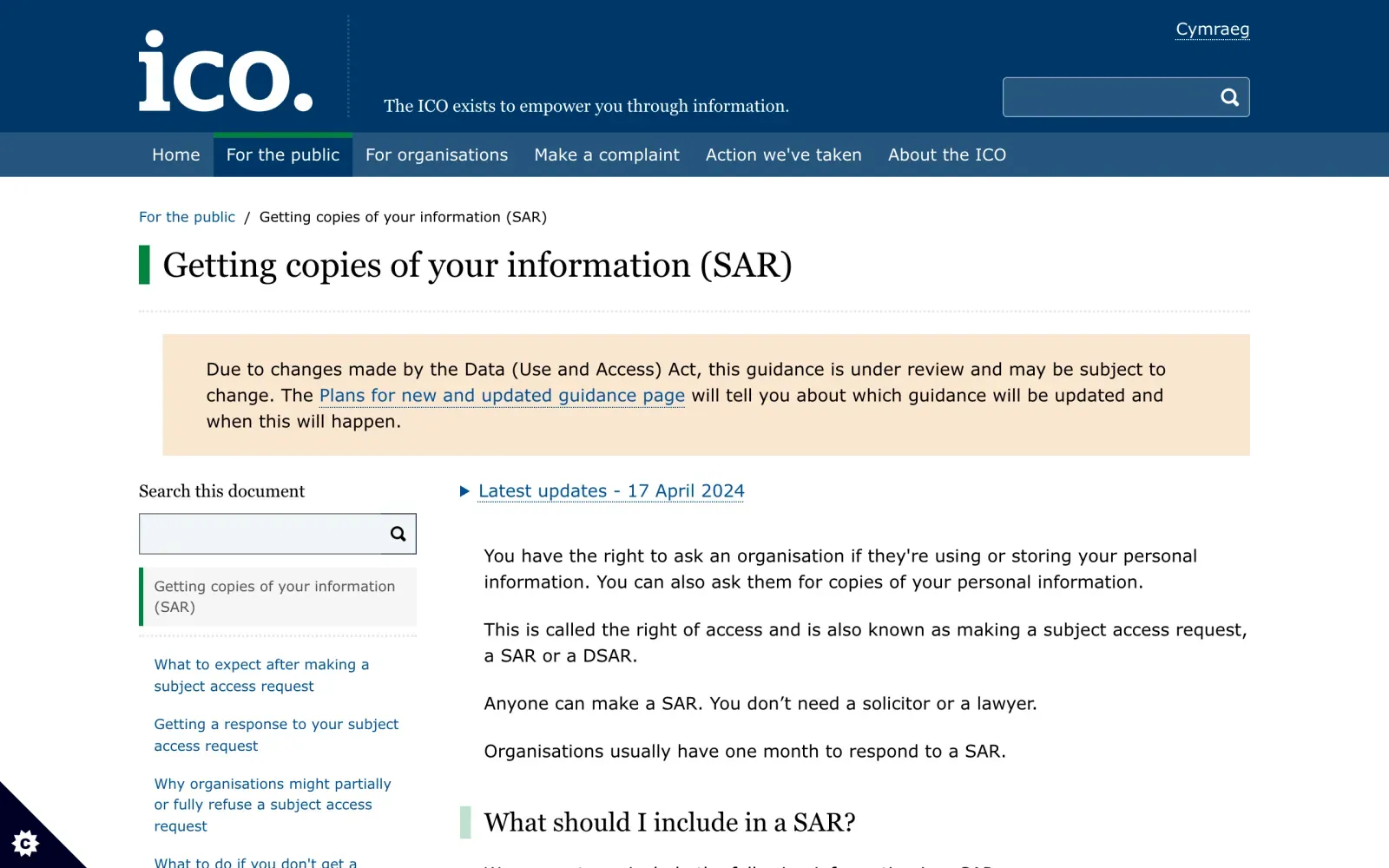
- Getting copies of your information (SAR)ICO, checked 15 November 2026
- What to expect after making a subject access requestICO, checked 15 November 2026
- Subject access request Q and As for employersICO, checked 15 November 2026